
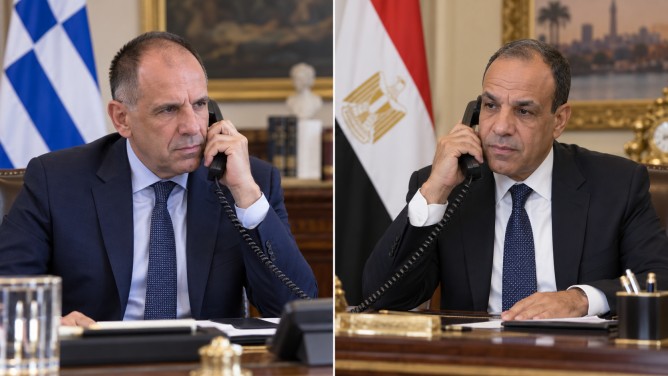
Greece and Egypt have agreed to initiate negotiations aimed at extending their maritime boundary in the Eastern Mediterranean. This decision comes amid growing tensions over maritime claims involving Turkey and Libya. Greek Foreign Minister George Gerapetritis and his Egyptian counterpart Badr Abdelatty discussed the extension of their exclusive economic zone (EEZ) agreement eastward during a recent phone conversation.
The current EEZ agreement between Greece and Egypt, signed in August 2020, delineates a boundary between the 26th and 28th meridians. The proposed extension would encompass waters east of the 28th meridian, which passes through the island of Rhodes. This strategic move follows Libya’s ratification of a maritime memorandum with Turkey, further complicating regional maritime disputes.
Athens and Cairo have expressed their opposition to the Turkish-Libyan agreement, arguing that it does not adequately consider the role of islands in determining maritime boundaries. They maintain that the agreement undermines the principle that islands should be factored into such delineations.
To advance the discussions on the proposed EEZ extension, Greece and Egypt are planning to commence technical-level consultations in the near future. In parallel, Greece intends to raise concerns regarding the Turkish-Libyan agreement with international bodies such as the European Union and the United Nations, seeking a coordinated response.
Turkey, however, stands by the validity of its maritime agreement with Libya, asserting that external evaluations cannot nullify the accord. The initiative by Greece and Egypt underscores persistent disagreements over maritime jurisdiction and influence in the Eastern Mediterranean region.